Graduate
University of California Los Angeles (UCLA): Ph.D. in Psychology (Major: Cognitive Neuroscience); M.A. in Cognitive Neuroscience.
Undergraduate
New York University (NYU); 2 B.A. Degrees in Philosophy and Psychology
What if clinically meaningful stress reduction didn’t take weeks — but minutes?
High-stakes professions demand clarity, emotional regulation, and rapid recovery under pressure. Pilots, operators, healthcare professionals, and executives are often required to perform at a high level while carrying accumulated stress. Traditional approaches—therapy, training protocols, or medication—can be effective, but typically require weeks of sustained effort.
A recent study examining Lumena’s MindGym explored a different question:
Can a short, immersive intervention produce immediate and measurable improvements in stress-related state?
Researchers evaluated the psychological impact of a single MindGym session, focusing on real-time changes in validated measures of stress and performance.
Key areas measured included:
These measures were assessed before and after the session, capturing immediate shifts in psychological state.
31% Reduction in Anxiety — In Under 12 Minutes
Participants experienced:
In clinical terms, this represents a substantial and meaningful shift in psychological state.
To provide context:
In minutes, MindGym achieved comparable magnitude in a single session.
The intervention demonstrated improvements across multiple domains:
Participants also experienced a significant increase in flow state, associated with:
These findings suggest system-wide nervous system regulation, not just isolated symptom relief.
Compared to similar light-based or meditation interventions:
This represents a step-change in both magnitude and efficiency.
These results provide a strong signal that rapid, non-pharmacological interventions can produce meaningful changes in psychological state. The magnitude and speed of these effects point to new possibilities for how stress regulation and performance support can be delivered.
As understanding of immersive, neuroscience-driven environments continues to evolve, approaches like MindGym play an increasingly important role in shaping how individuals and organizations manage stress, recovery, and cognitive readiness.
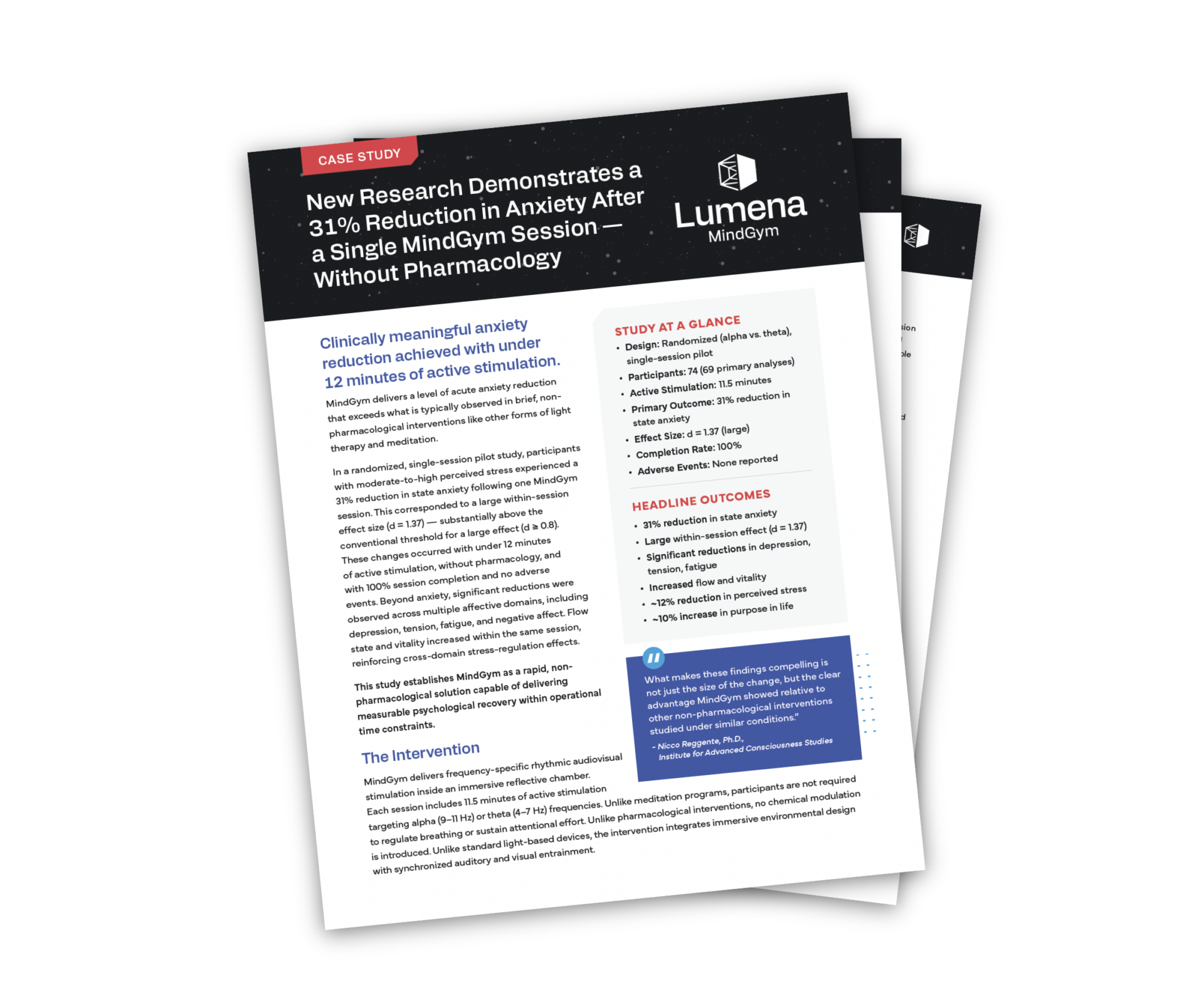
“What makes these findings compelling is not just the magnitude of change, but the clear advantage MindGym demonstrated relative to other non-pharmacological interventions studied under similar conditions. We observed reductions in state anxiety comparable to gold-standard clinical treatments, yet delivered in a single session.
The effect sizes substantially exceeded those reported for comparable light-based or meditation interventions. From a neuroscience perspective, this suggests we are engaging core mechanisms of stress regulation and neural state shifting in a way that is both efficient and measurably distinct.”
— Nicco Reggente, Ph.D.

Nicco Reggente, Ph.D., Research Director
Nicco Reggente, Ph.D. is a neuroscientist and co-founder of the Institute for Advanced Consciousness Studies (IACS) where he currently serves as Research Director. The overarching theme of his research is the development of neuroimaging-informed, personalized neurotechnology to help individuals achieve desired outcomes. Nicco’s research has spanned the domains of memory, consciousness, and psychiatric disorders. His current focus is on leveraging immersive technology to induce maximally beneficial qualia (e.g. meditative, entheogenic states) that can be captured and re-instantiated via neurofeedback. Dr. Reggente is passionate about creating research environments that combine academic rigor with startup culture, permitting for rapid deployment of empirically validated and ecologically valid neurotechnology. He currently serves as Principal Investigator on all research projects at IACS.